[Nota Bene: the webmaster of the Answering Abraham blog has been kind enough to include this guest post, by Denis Giron.]
Paul Williams recently posted an entry on his blog, titled Further thoughts on Christianity versus the Jewish Bible, in which he invokes a passage he has been hitting people with for years: Deuteronomy 30:11. His essential argument is a simple one: this or that English translation of Deuteronomy 30:11 gives the impression that the Mosaic Law is not difficult to keep, therefore any Christian (or even New Testament author) who says otherwise is contradicting Deuteronomy.
Readers can visit the relevant blog entry, and see, for example, Sam Shamoun, offering a detailed response to Mr. Williams' argument (assuming the censorship-prone Williams has not deleted said comment(s) by the time one reads this). I would like to make one small contribution to the discussion by noting what Rashi had to say on this issue. Here's a portion of Rashi's commentary on the relevant verse, as it appears in my copy of Miqra'ot Gedolot:
In the underlined portion, Rashi argues that the text is stating the commandment is not covered (or concealed, or hidden, which interestingly lines up with the KJV). Rashi goes on to support his stance by providing other examples of where the relevant verb means to cover or hide.
This, then, raises a question: being that even eminent Jewish authorities (who cannot be accused of some sort of Christian bias) understood the text as stating that the command is not hidden or covered, we need not consider it as necessarily being a comment on how difficult the Law is. For an analogy, I can put a quantum physics text book right in front of you (thus it will not be hidden, you will not have to go looking for it), but that in itself does not mean making it accessible to you is the same as it not being difficult for you to follow.
An Orthodox Jewish Scholar and ordained Rabbi, Dr Benjamin Sommer describes in one of his famous works why a multi-personal being is superior to a uni-personal being and more adequately rendered as being the one true God worthy of worship:
"The Bible’s fluidity traditions are not polytheistic. J and E and the other texts that evince the notion that God has more than one body never speak of other gods having any independent power or import, and they oppose the worship of other deities.74 Nevertheless, one may tend initially to think of the fluidity model, even in its monotheistic form, as closer to paganism and to view the antifluidity model as representing a purer monotheism. The emphatically embodied God of the fluidity traditions seems, at first glance, to lack the radical differentiation from humanity that must be required of a monotheistic conception of divinity. In any event, that is surely how P and D must have seen the matter. Further reflection shows the opposite to be the case. The fluidity tradition presents us with the most profoundly monotheistic perception of God in the Hebrew Bible.
Yochanan Muffs points to a tension that pervades and nourishes the entire Hebrew Bible. He argues that the tension between the concept of transcendence, which insists the Deity is not to be identified with the physis of the world, and radical personalism, which insists the Deity is anthropomorphically involved in the world, is the very source of the creative dynamism of biblical anthropomorphism.75
I would like to suggest that the fluidity traditions provide an especially deft resolution to this tension, a resolution that comes into focus when we contrast the fluidity model with some other theological models with which it might initially be confused. The notion of multiple embodiment, it must be stressed, is not identical with the idea that God’s presence pervades the world or, less pantheistically, the idea that the effects of God’s presence (which might also be termed God’s concern) pervade the whole cosmos, a notion expressed most eloquently and famously in Psalm 139.7–10:
Where can I go away fromYour spirit? Where can I escape your presence? If I ascend to heaven, You are there. If I make the underworld my bed, here You are. If I ride the wings of dawn to the nethermost west, There, too, Your hand will guide me, and your right arm will hold me in.
In these pantheistic or panentheistic conceptions, God can be equally present in all things and all places. The notion of multiple embodiment is something else altogether. Although they acknowledge that God’s power and concern can reach any place, the fluidity traditions maintain that God is literally located in some object sand not others: God is here, in this rock that has been anointed, but not there, in that one. In this regard, the fluid God retains a degree of transcendence that is lacking in the antifluidity traditions on the one hand and in pantheistic and panentheistic understandings of God as omnipresent on the other. The conception of God as multiply embodied allows for the possibility that God can be anthropomorphically involved in the world even as God is not identified with the world, because this God is bound to no one place. For a monotheistic religion that insists on God’s personhood and on God’s intimate concern with the world, the concept of multiple embodiment cuts the Gordian knot: God is not the same as the world’s physis, but God can choose to inhabit specific parts of the physis in order to be present to His worshippers.
This concept, then, seems almost inevitable as a consequence of the biblical stress on both transcendence and immanence. It is precisely when there is only a single divine body, on the other hand, that the tension between these two forces in biblical religion becomes so severe: If the divine person has one body, that body must be in a particular place. If that place is on the planet Earth, then God is clearly immanent but not transcendent. If that place is exclusively in heaven, then God is transcendent but not immanent. (In its most extreme forms, the tension produces a line of reasoning that leads to highly abstract conceptions of God that deny not only divine embodiment but even divine personhood [e.g., in the philosophicalwork of Maimonides or, quite differently, in the thought of Mordecai Kaplan].) In light of this tension as it emerges in the antifluidity traditions, it is not at all surprising that notions of multiple embodiment appear again and again in Judaism even after P and D attempted to stifle them. The fluidity traditions furthermore emphasize the radical difference between God as person on the one hand and humanity on the other. In fact, they do so much more strongly than priestly and deuteronomic writings in which God has only one body.76
Postrabbinic teachings according to which God has no body also stress the difference between God and humanity, but those teachings achieve this differentiation at the cost of the personal God. In this regard, Elaine Scarry’s statement that “to have no body is to have no limits on one’s extension out into the world”77 points toward a crucial point. A normal body – that is, a single body, constrained in space – is limited. But in the fluidity traditions, God differs from humans not in that God has no body, but in that God’s bodies are unlimited. A God who can be in various asherot and mas.s.ebot and in heaven at the same time is embodied but in no way constrained. Now, any physical God, whether a God with one body or with many, is a God who can change. Such a God, furthermore, is a deity in whom we can find pathos; a God who can change is a God who can experience joy and pain, loneliness and love. And that physical God of pathos, with one body or many, can seek out humanity.78 But only the God with many bodies can rise above God’s own physicality. The God with many bodies remains woundable and alterable, but this deity can nevertheless be omnipotent.
In short, the fluidity model manages, to a greater extent than the traditions that posit a single divine body, to preserve God’s freedom and transcendence even as it maintains the divine personhood and vulnerability so central to biblical and rabbinic literature. Here we note a significant irony. The most extreme antifluidity positions are those of the philosophers, especially Saadia and Maimonides, who insist that monotheism is incompatible with a belief in divine embodiment, as Moshe Halbertal and Avishai Margalit point out: For Maimonides the belief in the oneness of God meant not merely denial of polytheism, which is obvious, but, more important, denial of the perception of God himself as a complex being.
The description of God as one according to Maimonides refers mainly to his own “simple unity.” “Multiplicity” is therefore not only the belief in many gods, it is also an error that concerns God himself, which may be called “internal polytheism.”
The strict demand on unity implies a rejection of corporeality, which assumes that God is divisible like any other body.79 The essence of the fluidity model, however, lies precisely in the recognition that God’s divisible bodies are not in fact like any other bodies. God’s divisibility does not detract from God’s might or transcendence; because the number of divine bodies is potentially infinite, the disappearance or fragmentation of any one of them is, ontologically speaking, a matter of no concern. It follows that the fluidity model may preserve God’s uniqueness and transcendence no less than the philosophical theology of Maimonides.80
Further, the fluidity model is considerably less limiting than the priestly or even deuteronomic models. For P and for the Zion-Sabbaoth traditions described in Chapter 4, God was present in a particular sanctuary and nowhere else; according to these texts, we could once say, “God is Zion.”
For D and Dtr, God was emphatically not present in Zion or anywhere else under the heavens; according to them, we were able to say positively, “We know that God is not in Zion.” But for the fluidity model, we could only say, “God is to some degree present in Zion, and God may be elsewhere as well, if not today then tomorrow or yesterday.” The fluidity model makes God both accessible and unknowable. The depth of the fluidity model, then, is its extraordinary ability to bridge gaps, to be on both sides of what we thought was a polarity. “The value of anthropomorphism,” Mark Smith has written, deserves fuller consideration.
In some contexts it could convey the personal aspects of divinity and its accessibility in the face of a general notion of divine transcendence. If divinity is analogous to humanity, then divinity is perceptible as personal, as the paramount paradigm of personal relations remains human-human interaction.81
In the fluidity model, however, it is through a form of anthropomorphism that the analogy between humanity and divinity is broken down. It is of all things the God present in multiple bodies who is completely unlike us. Such a God is, to recall the poet Friedrich H¨olderlin’s words, at once nearby and hard to grasp:
Nah ist, und schwer zu fassen der Gott.82
Yair Lorberbaum points out that philosophers, theologians, and mystics reject anthropomorphism in part because they hold that a god with a body is exposed, visible, and hence not mysterious. (“A god who is understood is no god at all,” he quotes Augustine as saying).83
But in the fluidity model, precisely the opposite is the case. That model speaks of a God with a body, and hence a God who can be nearby, but its God is also radically unlike a human being, for God’s fluid self and unity across multiple bodies are fundamentally incomprehensible to humanity.
Rudolph Otto’s categories of “wholly other” and “mysterious,” we learn from the fluidity model, do not consist only of “transcendent” or “distant.” The immanent deity of the fluidity model can, mysteriously enough, be wholly other, even more so than the transcendent one. Yhwh’s fluidity does not render Yhwh something akin to a polytheistic deity, even though we saw in Chapter 1 that the gods of ancient Near Eastern polytheism were fluid.84
Rather, the perception of divinity we have explored here reflects Yhwh’s freedom, even as it expresses Yhwh’s grace – more specifically, Yhwh’s desire to become accessible to humanity. This conception renders God an unfathomable being, but nevertheless one with whom we can enter into dialogue.85 This God matters to a modern Jewish theology, as do the texts in which this God was first perceived."
[Nota Bene: the webmaster of the Answering Abraham blog has been kind enough to include this guest post, by Denis Giron.]
Last Monday, Paul Williams posted an entry on his blog, which simply contained the following portion from James Dunn's "The Living Word":
The most difficult case of all for Christians who hold the Bible in high regard: the Fourth Gospel [John]. Here the matter is peculiarly sensitive, since so much seems to depend on it. For if John’s Gospel is straightforward history, then we have in it the most amazing and powerful self-testimony of Jesus. If John’s Gospel is unvarnished history then then all that Christians need ever claim for Jesus is clearly attested there, and by Jesus himself. If John is correct, then the old apologetic-evangelistic question is unavoidable: the one who makes such claims for himself is either mad, bad or God.
But the very starkness and unequivocalness of these claims is what begins to raise the nagging question in the mind. If Jesus made such claims, why do the other Gospels make no use of them? What Evangelist having among the traditions which had been passed to him such wonderful sayings as the ‘I ams’ – ‘I am the resurrection and the life’; I am the way, the truth and the life’; ‘Before Abraham was, I am’; and so on – what Evangelist having to hand such sayings could ignore them completely? The question once raised, cannot be squashed into silence, since the integrity of that whole apologetic-evangelistic approach is at stake.
I have attempted to discuss this subject with Mr. Williams before, but he has unfortunately ignored what was presented to him, only to return to his original position, as if he has yet to come across any rebuttals. Therefore, here I would like to present the arguments which have been presented to Mr. Williams, so that others might have one possible response whenever he takes an approach like that captured in the excerpt, above.
To begin, the question posed by Dunn (as well as others, like E.P. Sanders) should be examined. How do we explain the Gospel of John having material which the Synoptics lack, yet which some would speculate the Synoptic authors would have used were it available to them? In a correspondence which I had with Mr. Williams on FaceBook, in the summer of 2012, I proposed that a good place to start might be John 21:25.
That verse is important, and relevant, because it demonstrates that the Christian position should be that what appears in the four Gospels captures only a small fraction of all that Jesus said and did. Even without the witness of John 21:25, it should be obvious that such is the case. Note that there are just under fifty thousand words in the Greek text of the Synoptics. If one were to guess that half of that is quoting Jesus, then the conclusion would be that one could read aloud all statements attributed to Jesus by the Synoptics within just a few hours. Ergo, the statements attributed to Jesus in the Synoptics represent only a very small fragment of what would have been said during a multiple years long ministry. This would mean there is considerable material which is not included in the Synoptics, which would in turn mean it would be misguided to consider the statements in John to probably be fictional simply because they differ from the Synoptic fragment.
Once that is understood, the next point to be made is that the initially intended uses for each Gospel (or for the Synoptics vis a vis John) could have differed from one another, thus resulting in one corpus drawing out portions which do not appear in another. The Greek Orthodox priest John Romanides offered an explanation precisely along these lines:
[T]he Gospel of John has the mysteries as its basis and as its purpose the correlation of the historic life of Christ with the present mysterial life in Christ and experience of the community. When we take into account that the Christians carefully and systematically avoided all discussions of the deeper meaning of the mysteries, not only with the hostile outside world but even with the catechumens, then we are able to understand the use of the Gospels in the first Church, and many of the problems raised by biblical criticism are solved. Since the baptized Christians did not discuss the mysteries even with the catechumens, it is sufficiently clear that the fourth Gospel was used in the ancient Church for completing and finishing the catechism of the recently illumined, that is newly baptized. It was particularly suited to this purpose and distinguished from the other Gospels mainly because of its clear dogmatic, mysterial, and apologetical tone. We do not find in John the systematic preparation of catechumens for that is found in Matthew and Mark. This is why John does not begin with the baptism of Christ but with "In the beginning was the Logos...and the Logos was made flesh."[1]
Similarly, Joachim Jeremias argued[2] at length that there is evidence within the New Testament itself that different authors deliberately abstained from including deeper traditions in certain texts, out of concerm that such was not appropriate. Jeremias also argues that such carefulness was common among both Jews and non-Jews in the ancient near east. Such a practice lasted for centuries among Christians, as, in the fourth century, bishops in Alexandria expressed alarm at the fact that the deeper mysteries of the faith were being exposed to catechumens and non-believers, when they wrote:
They are not ashamed to parade the sacred mysteries before Catechumens, and worse than that, even before heathens: whereas, they ought to attend to what is written, 'It is good to keep close the secret of a king;' and as the Lord has charged us, 'Give not that which is holy unto the dogs, neither cast your pearls before swine.' We ought not then to parade the holy mysteries before the uninitiated, lest the heathen in their ignorance deride them, and the Catechumens being over-curious be offended.[3]
Therefore, it should not be any surprise that the aforementioned Father Romanides summed up the issue thusly:
The differences between the Synoptics and the Gospel of John, therefore, are not disagreements as many maintain. On the contrary, they clearly pertain to a difference in depth and fulfillment of the Synoptics by the fourth Gospel in accordance with the catechetical needs of the Church.[4]
The simple conclusion from all of the above is that the differences between the Synoptics and John need to necessitate that material distinct to the latter is fictional. It is entirely possible for different NT authors to have sufficient reason to not include a given tradition in a given text, even if the critics are unable to discern such reasons.
What about the Qur'an?
Interestingly, the argument can be placed back on the Qur'an. The Qur'an has material which does not appear in the Synoptics, yet which we might speculate certain authors would have wanted to employ. For example, consider the story in Soora Maryam 19:27-33, where Christ engages in public theological discourse while still an infant, in defense of His mother. Being that Matthew and Luke affirmed the doctrine of the Virgin Birth, might we not think they would have wanted to include a tradition in which her own child miraculously defends her before a crowd which had insinuated she had become pregnant via improper relations?
Any argument a Muslim attempts to raise in defense of the Qur'anic text will ultimately affirm (whether tacitly or overtly) this simple point: even if a text which came after the Synoptics has material that does not appear in the Synoptics (including material some might think the Synoptic authors might have wanted to use), that need not reflect negatively on the historicity of said material. Once such a point is conceded, it undermines any Muslim use of the relevant argument against John.
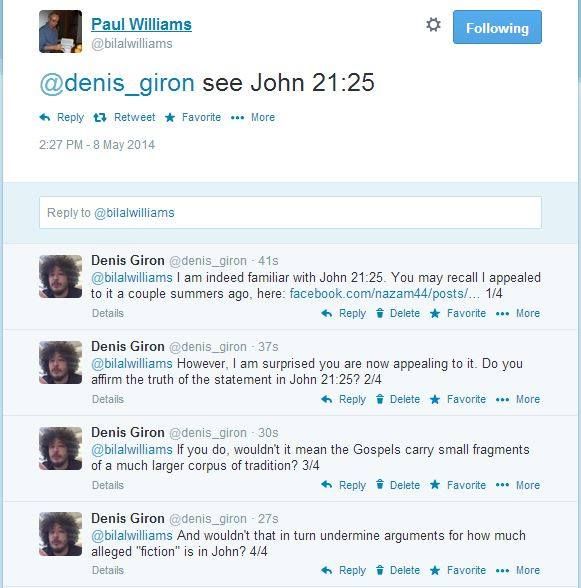
It is worthy of note that I presented precisely this point to Mr. Williams, via Twitter, last Spring:
Amazingly, Mr. Williams' sole response was to throw back at me the very verse I had appealed to in a correspondence with him nearly two years prior (John 21:25):
I tried to discuss the issue further with him, but he, unfortunately, had no further comment. While no disrespect is intended, I feel compelled to remark that I take this as evidence of an unwillingness on Mr. Williams' part to fully accept the full implications of the arguments and methodologies which he employs as a stick with which to beat Christianity.
End Notes
John S. Romanides, The Ancestral Sin, (Zephyr, 2002), pp. 72-73.
Joachim Jeremias' The Eucharistic Words of Jesus, (Oxford, 1955), 73-86.
The Encyclical Letter of the Council of Egypt, in Athanasius, Defence Against the Arians, part I, chapter 11, in Philip Schaff & Henry Wace (eds.), Nicene and Post-Nicene Fathers, (Cosimo, 2007), vol. IV, p. 106.
Firstly the Atheist explains what evidentialism is:
I believe there are other evidentialists liking this video long side of the Atheists evidentialists:
Did you observe some really large loopholes the Atheist is jumping into?
Other commentators certainly have.
One person even made a video responding with a few objections:
So the "evidentialist" atheist saw some of these objections and then attempted to defend evidentialism:
Firstly a small comment. The atheist asserts he is not making whatever assumptions he would like and then mentions assumptions he would like to make but is not. However this only proves he is making less assumptions than he would like to be, but he is still making a number of assumption that he does like. He contrasts himself with Theist Evidentialists who make a number of assumptions they would like, but less assumptions than they want. However none of this shows one assumption is better than another, which ought to be the case.
I post these two videos as an example of a good model to show how reality is oft assumed and represented in an evidenced based conversation in general. It is nearly always assumed that the burden of proof is on the one who makes an assertion (positive statement) therefore requiring evidence which is justification for possessing knowledge. Rather humans should begin on any possible common ground which would begin with axioms, properly warranted beliefs. It is often mistakenly assumed as a general rule of thumb that all beliefs require justification. There are millions of Christians who share a similar epistemology to our atheist friend sometimes unknowingly adopting evidentialism as the ipso facto approach or methodology to pursue in a productive dialogue or conversation with an atheist, or even a sound epistemology in general for those Christians who are aware of it.
I remember as a sixteen year old teenager, being asked in one of my very first encounters with an atheist: "What evidence do you have for your God?". I immediately began to explain how the universe required a beginning and therefore a transcendental cause, how creation required a creator, how a painting requires a painter, how many things appear to be designed and therefore show us a designer.
What I didn't know consciously was that the swing of burden of proof was shifted and then committed unto me. What I didn't know was that certain special types of beliefs do not require justification and therefore can plainly be called assumptions or presuppositions. What I didn't know is that all humans had these kinds of beliefs either, yet most were unaware of them. As René Descartes stated some types of beliefs are "self-evident", or at-least many beliefs rest on unjustifiable meta-beliefs.
I presented you these two videos so not only do you get an idea of what attitude atheists in general
adopt in a conversation with a believer but the underlying epistemology they utilize which at times is unfortunately either knowingly or unknowingly adopted by the Christian Theist. Between the years 2008-2014 I would of been some what impressed with these videos as an atheist, as it appears (as the video suggests) that evidentialism is some what self evident, it's part of our make up, our cognitive psychology as humans, our daily experience. I would believe it's rational to make these kinds of necessary assumptions and believe that all humans ultimately mustshare in this process with me, that simply adding God on top was either unnecessary or superfluous. Together as humans we can all take on the most basic weak assumptions and build out way to the top from the bottom so to speak.
To end this post, I don't plan on giving a highly detailed review or critique of evidentialism, rather I want to bring forth awareness and hope that my pressupositionalist (and other) readers will identify severe problems contained within the video.
He originally asserts that: "I exist" in the first video is self evident and can be known and inferred intuitively, while in the second video he classifies this as an assumption along with others. So I will assume since his second video is the accurate one, and that he views self existence as an assumption. But since he does not accept coherentism or verificationism, perhaps he actually holds both views and therefore is a consistent atheist by being inconsistent. The irony being: to be a consistent atheist is to be inconsistent.
Hence his three basic presuppositions he makes, firstly I exist. Secondly something other than me exists (and therefore my senses are sometimes accurate) and finally physical evidence is the standard to determine what is a justifiable belief.
However at the end of the second video, he ends by saying:
"I think this is a sufficientamount of defense for evidentialism to justify moving on. If you would like to present an alternative epistemology that you think better explains justification, you're free to do so...but I think I've sufficiently justified evidentialism to the point we can talk about what happens when we apply evidentialism to the hypothesis of God (17:17)"
I would now like to just present a few quotation from his first video that may seem at odds with his conclusion.
"How do I know that anything outside of myself exists? How do I know I'm not just experiencing a dream? How do I know i'm not just a brain in a vat experiencing a computer simulation? How do I know that I myself, am not just a program in a computer simulation? The answer is: I don't. I don't know that anything I see or experience is actually real, I have to make a presupposition, an assumption (2:44)"
And:
"But without the presupposition that at least some of my perceptions are accurate I have no where to go epistemologically, without this presupposition it is game over. I maybe wrong, I may actually be a brain in a vat experiencing simulated illusions but I have no choice but to at least initially assume that I am not just a brain in a vat, If I want to go anywhere meaningful epistemologically. (3:58)
And:
"Even for the purpose of defending the use of evidence, I have to use evidence (5:56)"
Hence none of his presuppositions have explanatory power, they are purely assumptive in nature, and none of them are justified, so I must disagree with his conclusion.
On his third presupposition (which he unjustifiably argues for using evidence) he sets a false dichotomy between evaluating God with evidentialism or rationalism, rather than using God as an initial presupposition that we have no choice but to use in evaluating these epimsteologies to begin with. He judges that evidence is the basis for math and logic and concludes rationalism will be eventually become obsolete:
"The learning process is extremely evidence based...in fact I suspect that evidentialism will win this argument precisely because it's the actual basis of human learning and rationalism isn't"
Of course the actual basis of human learning, the fact that humans learn some truths via evidence as children has nothing to do with evidentialism or rationalism being true or false.